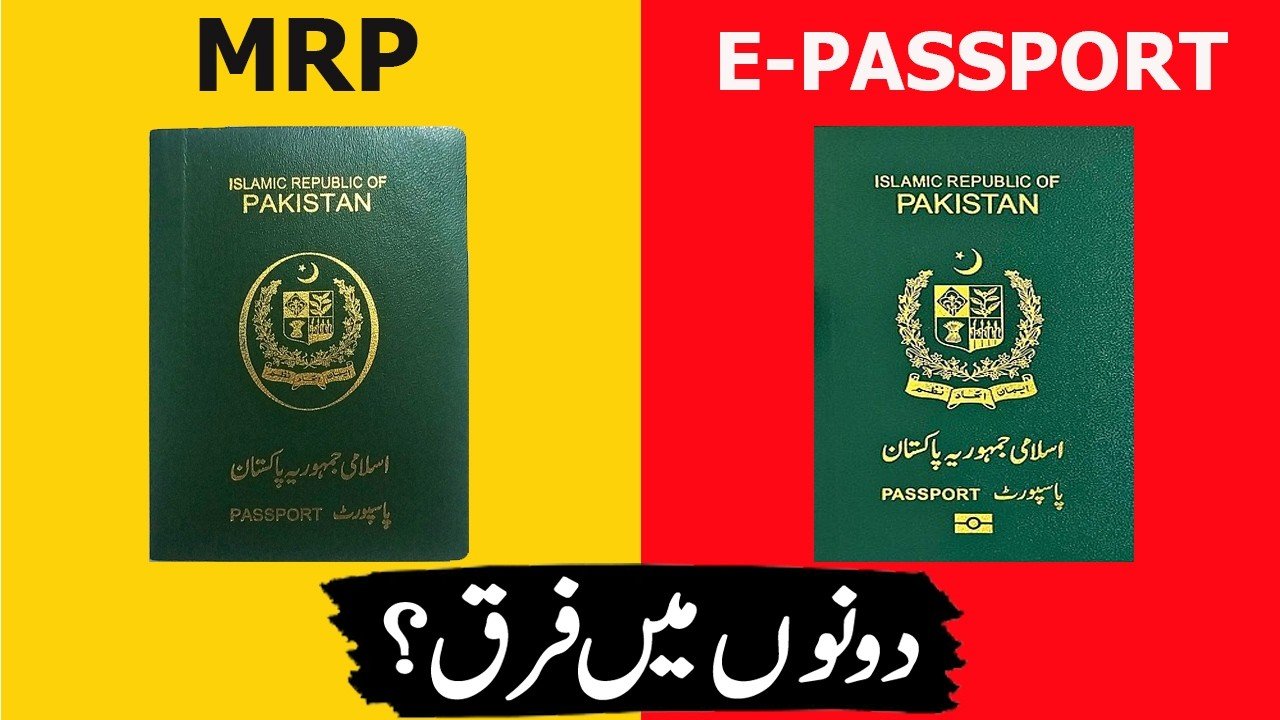
Short answer first, since this is what most people actually want to know: the e-passport has a chip embedded in its data page that stores your photo and fingerprints, while the older MRP doesn’t. That one difference is what drives almost everything else, the cost, the security, and whether you get to use e-Gates at the airport.
Here’s the longer version, with the actual details.
Quick Comparison Table
| Feature | MRP (Normal Passport) | E-Passport |
|---|---|---|
| Data page material | Paper | Polycarbonate (a tough plastic) |
| Embedded chip | No | Yes, with antenna for wireless reading |
| Stores fingerprints | No | Yes |
| Extra security features | Standard | About 29 additional features |
| e-Gate access at airports | No | Yes |
| ICAO compliance | Basic | Full |
| Pages available | 36, 72, or 100 | 36 or 72 (currently) |
| Fee (36 pages, 5 years, normal) | Rs. 4,500 | Rs. 9,000 |
| Fast Track (2-day) service | Available | Not available |
What’s Actually on That Data Page?
In an MRP, the data page is just paper, your photo and details are printed on it, and a machine reads the printed code at the bottom.
In an e-passport, that same page is made of polycarbonate, a hard plastic instead of paper, with a tiny chip and antenna built right into it. That chip holds your photo, your fingerprints, your personal details, a unique ID number, and a digital signature. Because it’s contactless, an e-Gate machine can read it just by holding the passport near a scanner, no swiping needed.
Why the E-Passport Is Harder to Fake
Pakistan’s e-passport isn’t just “a passport with a chip.” When it was rolled out in 2022, DGIP added roughly 29 new security features on top of everything the MRP already had. A few worth knowing about:
- Laser engraving on the data page, which is much harder to alter than printed text
- Holograms and rainbow printing that change appearance depending on the angle
- UV (ultraviolet) ink that’s invisible under normal light but shows up under UV scanners
- Microtext and deliberate “errors” that are too small to copy accurately by hand or by most printers
- Multiple Laser Image (MLI) technology, which displays different images depending on the viewing angle
The cover design changed too. The MRP has the state emblem sitting inside a gold oval on the front cover. The e-passport drops that oval for a cleaner look, and adds a small chip symbol to show it’s electronic.
The Fee Difference
The e-passport costs roughly double the MRP at the same page count and validity. For a 36-page, 5-year passport, that’s Rs. 9,000 versus Rs. 4,500. You’re paying for the chip, the polycarbonate page, and the added manufacturing cost.
For the complete breakdown across all page counts and validity options, see our full e-passport fee guide.
Pages and Validity
Both options let you choose between 5-year and 10-year validity. Where they differ is page count: MRP comes in 36, 72, or 100 pages, while the e-passport is currently offered in 36 or 72 pages only, based on the official DGIP fee chart. If you specifically need a 100-page passport for heavy travel, that’s an MRP-only option right now.

e-Gates: The Practical Everyday Difference
This is the one most travelers actually notice. With an e-passport, you can use self-service e-Gates at many international airports, scan your passport, look at the camera, and walk through, instead of waiting in the regular immigration line. An MRP doesn’t give you that option; you’ll go through manual checks every time.
Processing Time
| Service | MRP | E-Passport |
|---|---|---|
| Normal | 21 working days | 21 working days |
| Urgent | 5 working days | 5 working days |
| Fast Track | 2 working days | Not available |
If you need a passport in two days, the e-passport simply isn’t an option, you’d have to apply for an MRP instead.
So Which One Should You Choose?
If you travel often, want the e-Gate option, or just want the more secure document, the e-passport is the better pick, even with the higher fee. If you need something quickly (within 2 days) or want the cheaper, simpler option and don’t care about e-Gates, the MRP still works fine and is fully valid for international travel.
Both are issued by the same department, both meet the basic requirements for travel, and one isn’t “more legal” than the other. It really comes down to budget, how soon you need it, and whether e-Gate access matters to you.
Frequently Asked Questions
What is the difference between an e-passport and a normal passport? The e-passport has an embedded chip that stores your photo, fingerprints, and personal data, along with extra physical security features. A normal MRP doesn’t have any of that; it’s just printed paper read by a machine.
Is the e-passport mandatory in Pakistan? No. As of June 2026, you can still apply for the regular MRP. The e-passport is an upgrade option, not a requirement.

Can I still get a normal MRP instead of an e-passport in 2026? Yes, the MRP is still available, and it’s actually your only option if you need Fast Track (2-day) service.
Is the e-passport accepted everywhere the MRP is accepted? Yes. Both are valid international travel documents issued by the Government of Pakistan and accepted worldwide.
This page is part of our complete e-passport series. For the full process, see our step-by-step apply guide, and for pricing, check our complete e-passport fee guide.